When I was a boy, my dad was the custodian at our school. Almost every day he would take me into the gym and give me basketball lessons. In our town, basketball was more than a game. It was who we were. So when I had a bad night on the court, it felt like I had let down more than myself. After one of those games, my dad sat with me and said something I have carried ever since: “Sometimes perfection haunts you.” Everybody has a bad day, he told me. The answer was not to quit. The answer was to come back to the gym tomorrow and keep working.
I have been thinking about my dad this week. The election is over. Some of us woke up relieved. Some of us woke up disappointed. A lot of us simply woke up tired. But underneath all of those feelings, many Americans share a quieter worry. We feel that our democracy is not delivering a society where everyone belongs and everyone has a good chance to thrive. That worry does not belong to one party. I hear it from people across the whole range of political views, in churches, service clubs, libraries and kitchens.
Here is what I believe that worry is telling us. The era of “voting and forgetting” is over. For a long time, many of us treated democracy like a service we pay for. We cast our vote, and then we waited for someone else to fix things. When they didn’t, we got angry and waited for the next election. Voting matters deeply, and protecting it matters. But voting was never meant to be the whole of citizenship. It is one part of a much bigger job.
The good news is that people are already doing that bigger job. In towns, cities and neighborhoods all over the country, Americans are rediscovering what active citizenship looks like. They are sitting down with neighbors they disagree with. They are solving local problems together, from housing to schools to the health of their main streets. This is a transpartisan movement. It is not left or right, and it is not about winning the next fight. It is about rebuilding the trust that lets a community work at all.
I want to be careful here, because there is a trap in how we talk about democracy. It is easy to believe that a system must be perfect before we can trust it or invest in it. That is the same thing that haunted me after a bad game. No human system is perfect, and none ever will be. Imperfection is not a reason to give up. It is an invitation to improve. Our goal is not a perfect democracy. Our goal is a more functional one, where people can work through hard problems together and still see each other as neighbors when the meeting is over.
That kind of democracy does not come from a new law alone, and it does not come from one more election. It comes from people engaging with one another, again and again, until the habits of trust grow stronger than the habits of suspicion. When enough of us do that, we start to rewire our democracy from the ground up. We build the society we deserve, not by waiting for it, but by practicing it.
Many of us grew up hearing that we should love our neighbor as we love ourselves. That is not a slogan. It is a way of life. I believe the same is true of the first three words of our Constitution. “We the people” is not just poetry. It is a job description. And like any job, it takes skills. It takes the skill of listening to someone whose life looks very different from yours. It takes the skill of staying in the room when the conversation gets uncomfortable. It takes the skill of looking for the shared problem underneath the argument. Nobody is born with those skills. We learn them the way I learned to shoot a basketball: by showing up and practicing with other people.
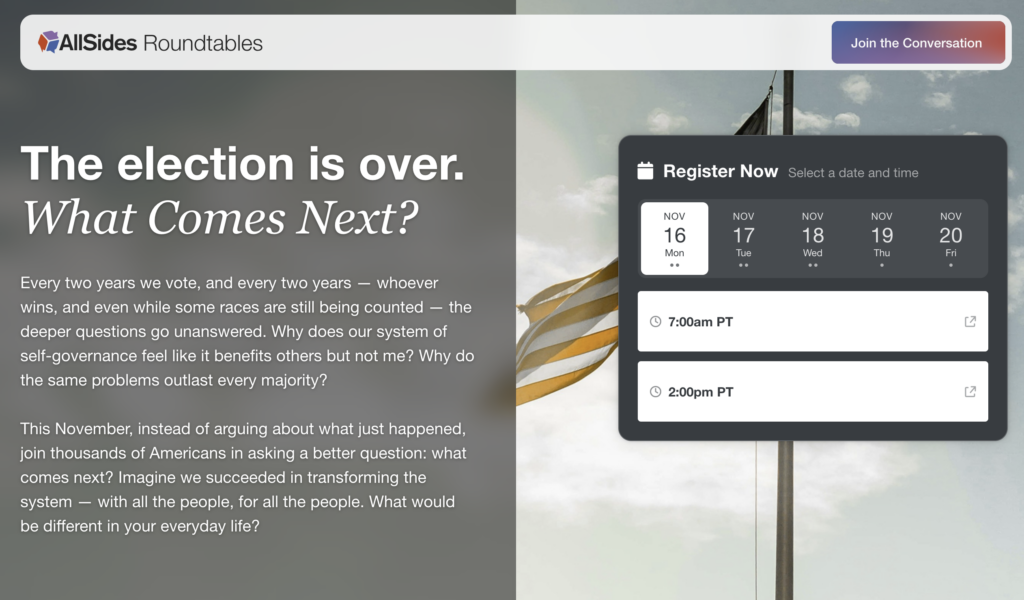
So here is an invitation to practice. Paths to Understanding is proud to co-sponsor a national AllSides Roundtable called Once the Election Is Over, What Comes Next? From November 16 to 20, AllSides will host eight free, one-hour sessions online, at different times of day so people in every time zone can take part. You choose the one that fits your life.
This is not a debate, and it is not a panel of experts talking at you. You will join a small video conversation with four to six people you have never met, people who may see the world quite differently than you do. A simple, proven guide will help the group talk and listen well. You don’t need special software, just a computer or phone with a camera. In one hour you will practice the very skills our communities need most, and you will leave with a clearer sense of what you can do next where you live.
Each group will work through one hopeful question. Imagine we succeeded in renewing our democracy, with all the people and for all the people. What would be different in your everyday life? From there, the group talks honestly about what stands in the way and what would have to change. What you share will be anonymized and gathered into a national report this winter, and it will help shape a monthly series of citizen conversations beginning in January. This is a conversation that goes somewhere.
If you are relieved by the election, come. If you are disappointed, come. If you are just worn out, please come too. And if you can, bring someone along who sees things differently than you do. That may be the most powerful thing you do all month.
My dad was right. Everybody has a bad day, and every nation has hard seasons. The answer is not to walk away. The answer is to come back to the gym and keep working, together.
Register for one session at allsides.com/whatcomesnext.