Why Paths to Understanding is part of Faith in America — and what we can all do before November 3
The contract we already share
Across the wisdom traditions we walk with — Christian, Jewish, Muslim, Buddhist, Hindu, Sikh, Indigenous, humanist and many more — there is remarkable agreement on two things. Every person has a dignity that no one granted and no one can take away. And every group of people is fully human: no community is less than human, and no people is disposable.
Our traditions say this in different languages. The monotheistic traditions speak of one Creator in whose image every person is made, and they command us to love our neighbor as ourselves. Others arrive by other roads — the Buddhist insight that no one is separate from anyone, the Confucian work of right relationship, the humanist conviction of a shared human condition, the Coast Salish practice of calling witnesses so that what a community decides is remembered and honored together.
Call this the social contract. Long before philosophers gave it a name, our traditions were teaching it: we thrive together, or not at all.
The civil contract built on it
On that social contract, our nation built a civil contract. Citizens take part in shaping policy at every level — school boards and city councils, county commissions and state legislatures, Congress. We elect representatives at all of those levels, and we lend them power for a set term. The power belongs to the people. Those we elect hold it temporarily, under an oath or affirmation to uphold the Constitution and the laws, and they hand it on when their term ends or when the voters decide.
The founders did not fully live up to the promise they wrote down. “All men are created equal” named something larger than the men who wrote it, and generations have worked to widen who it includes. But the structure they built still holds: an election is where the lending of power is renewed.
Why we are part of Faith in America
That is why Paths to Understanding has joined Faith in America as a leadership partner. It is a nonpartisan partnership of national organizations — Braver Angels, Interfaith America, the National Institute for Civil Discourse, Faith250, Living Room Conversations, the Listen First Project and the International Center for Religion and Diplomacy — working together to support elections that are free, fair and safe, and results that are honored until they are lawfully changed.
Our traditions also teach us to hold two true things at once — love of self and love of neighbor, justice and mercy. Elections ask the same of us. Only eligible voters should vote; that is what fairness means. And every eligible voter should be encouraged and able to vote, safely, and have that vote counted. These are not rival teams. They are one commitment seen from two sides.
See my article for Faith in America on The Fulcrum on September 28th.
When trust is low, we return to what we value
Trust in our institutions has been falling for years, among people of every political persuasion. Some of that distrust has causes worth taking seriously. But it also opens the door to a dangerous idea: that since nothing works, the rules no longer apply.
Our traditions offer a different way forward. When trust is low, we go back to our core values — the dignity of every person, the humanity of every group, truthfulness, love of neighbor — and decide from there how to move forward. A broken promise calls for holding one another to it, not for giving up on promises altogether.
What to watch for this fall
Election officials and nonpartisan experts are watching several issues as November 3 approaches. None is a reason for alarm. Each is a reason to vote early, check facts, and show up for one another.
- Mail ballot timing. Postal rules on postmarks have changed. In Washington, where everyone votes by mail, the safest choice is an official drop box — or mail your ballot well before Election Day.
- New district lines. An unusual number of states redrew congressional maps mid-decade. Check your district and your sample ballot.
- Registration and voter rolls. States are updating their rolls, and federal requests for voter data and new citizenship checks are being tested in court. Accurate rolls protect both integrity and access. Confirm your registration now — in Washington, at VoteWA.gov.
- Changing rules. Federal orders and legislation on citizenship verification and mail ballots have been the subject of several court rulings this year. Your state or county election office is the authoritative source for the rules that apply to you.
- Election officials and poll workers. Local officials report harassment, staff turnover and strained resources. Elections depend on trained poll workers and a respectful public.
- False information and AI fakes. Convincing fake images, audio and documents are now easy to make. Check claims about when, where and how to vote with your election office before sharing them — especially the ones that confirm what you already believe.
- Intimidation at the polls. Federal and state laws prohibit intimidating voters. A calm, respectful presence helps everyone.
- Slow counts. Election-night numbers are unofficial. Totals change for days as mail and provisional ballots are counted. That is careful counting, not fraud — and in Washington it happens every election.
- Certification. Certifying results is a legal duty with firm deadlines. Results should be certified on time and honored.
What Faith in America is doing
- Praying for America. Two nationally broadcast gatherings on Sunday, October 11 and Sunday, November 1, at 7 p.m. Eastern / 4 p.m. Pacific — with no political speeches, no signs and no partisan name-calling. Learn more and register.
- I Have Faith in America. Record a one-minute video about why free, fair and safe elections matter to you — on your own or, better yet, with someone you disagree with politically. Make a video.
- Resources for local communities. Materials to help congregations and community groups host their own gatherings in the weeks before the election. Host your own event.
- More ways to take action. Links to trusted, nonpartisan election resources, including Interfaith America’s Faith in Elections Playbook and VOTE411. See the list.
We are not alone in this
Faith in America is one effort among many. We are grateful for others in our wisdom traditions doing this work, including:
- Interfaith America — the Faith in Elections Playbook, a practical guide for congregations.
- Interfaith Alliance — The Vote Is Sacred: nonpartisan voter education and a trained, peaceful presence at polling places.
- Faiths United to Save Democracy — Poll Chaplains and Peacekeepers: training clergy and lay volunteers to be a calm, moral presence at the polls.
- Jewish Partnership for Democracy — Faith in Fair Elections: recruiting poll workers, poll chaplains and trusted messengers.
- Religious Action Center of Reform Judaism — Every Voice, Every Vote: voter registration and election-protection training for congregations.
- Franciscan Action Network — Faith in Democracy: recruiting and training poll workers and poll chaplains.
- United Church of Christ — Our Faith, Our Vote: a nonpartisan toolkit for congregations.
- Faith in Us – https://faithinusleading.org/ – An organizing method of response to activate local leaders.
Resources from Paths to Understanding
We keep a folder of resources for congregations and community groups, and we are adding to it as the election approaches. Find the PTU election resources here.
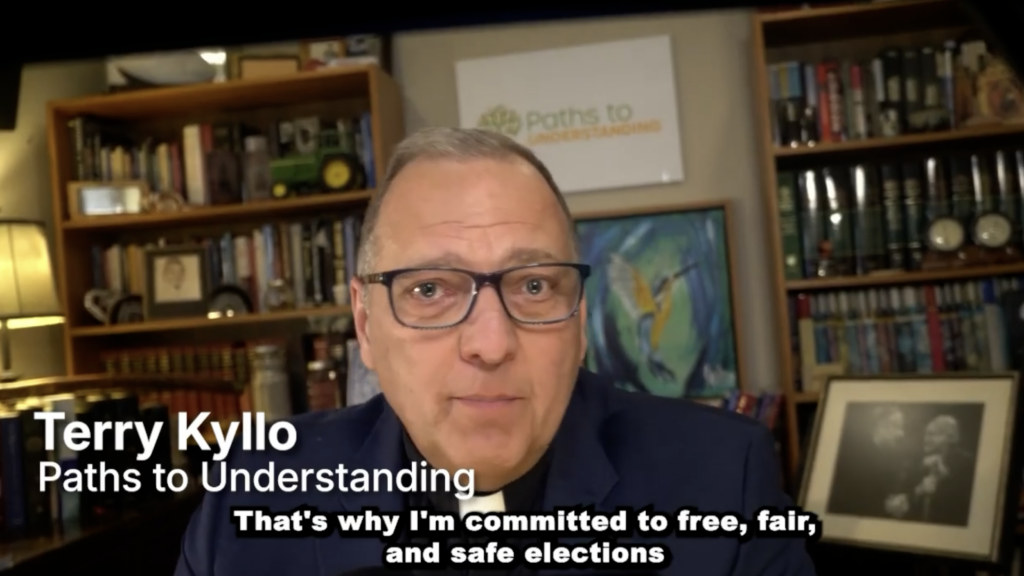
Here is my Faith in America Testimonial:
Vote. Help a neighbor vote. Tell the truth, and check before you share. Pray for an honest count and for the dignity of those who lose. And honor the result. That is how a people keeps the promises it has made to one another.