
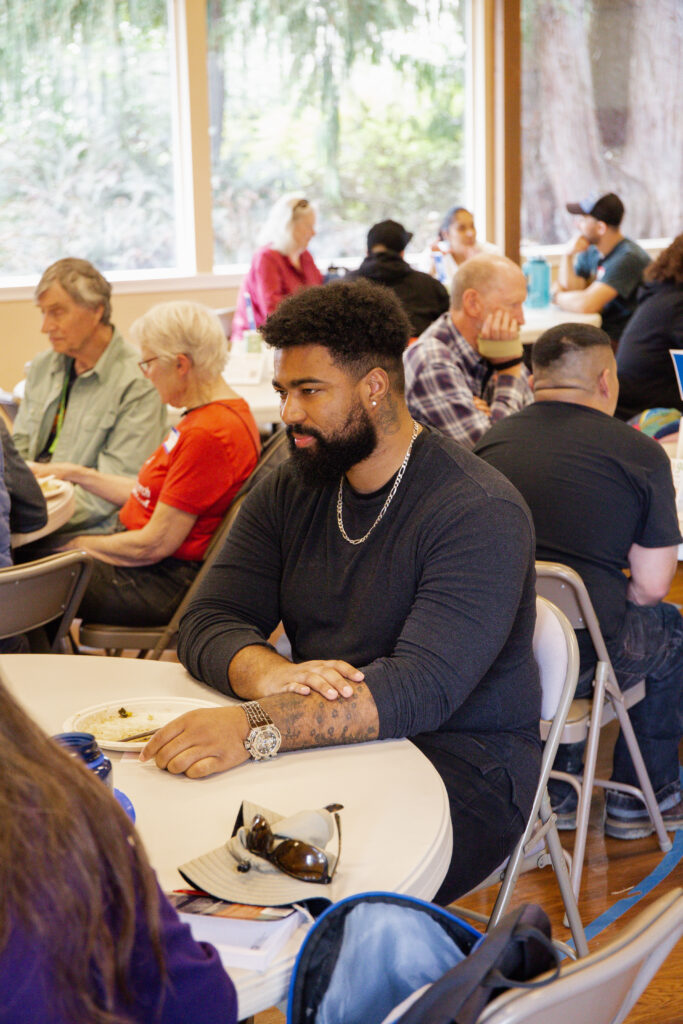
Our differences are not the problem—our distance is
There is a growing message in our country right now.
Some leaders—including JD Vance and Steve Bannon—are saying that our diversity is the problem.
Different cultures.
Different traditions.
Different identities.
The argument goes like this:
If we were more alike, we would be more united.
It’s a simple idea.
But it’s wrong.
What’s really going o
The problem is not our differences.
The problem is our distance.
Distance creates misunderstanding.
Misunderstanding creates fear.
Fear creates division.
And when that division deepens, we begin to tell a dangerous story:
Those people are the problem.
But the truth is much closer to home.
Most of us don’t actually know people who are different from us.
We live in different neighborhoods.
We gather in different spaces.
We consume different media.
Over time, we don’t just disagree.
We drift apart.
What happens when distance grows
When we lack real relationships across difference:
- We fill in the gaps with assumptions
- We believe stories about each other that aren’t true
- We reduce whole groups of people to a single idea
And eventually, we stop seeing each other as fully human.
This is how the civil contract breaks down.
Not all at once.
But slowly—through distance.
And then we not only feel less save, we are less safe – not because of the other but because we have neglected the relationships that make us safe.
What we discover when we get closer
Here’s what I’ve seen over and over again.
When people actually come together—across religion, culture, politics, and identity—something surprising happens.
They don’t become the same.
But they begin to recognize something deeper.
Across traditions, across time, across the world, we find shared values:
- Treat others as you want to be treated
- Care for the vulnerable
- Tell the truth
- Act with humility
- Seek the common good
These are not just “religious teachings.”
They are human teachings.
They form the foundation of how communities hold together.
The deeper role of wisdom traditions
Every wisdom community—whether religious or not—has developed ways to answer a basic question:
How do we live together?
And their answers often sound remarkably similar.
Not identical.
But aligned.
These teachings:
- Shape how people treat one another within their community
- And guide how they relate to people outside their group
In other words:
They are not just private beliefs.
They are the building blocks of the social contract.
The mistake we are making
When we blame diversity, we are solving the wrong problem.
We are trying to reduce difference…
…when what we actually need is to reduce distance.
Because difference, on its own, is not dangerous.
Distance is.
Distance is what allows fear to grow.
Distance is what allows dehumanization to take hold.
Distance is what weakens the bonds that hold a society together.
A different path forward
If distance is the problem, then the work becomes clearer.
We don’t need to become the same.
We need to become connected.
This means:
- Creating spaces where people can meet across difference
- Asking questions about life, not just opinions
- Listening for values, not just positions
- Working together on things that matter locally
This is how belonging begins.
And as belonging grows, something else grows too:
Civic muscle.
Our ability to solve problems together.
What I am seeing
Across the country, I see people doing this work.
Quietly.
Patiently.
They are not trying to erase differences. They are building relationships across them.
And in doing so, they are renewing something deeper than agreement.
They are renewing the civil contract.
What I’m learning
We do not need less diversity.
We need less distance.
Because when we get close enough to one another…
We don’t lose our differences.
We rediscover our shared humanity.