
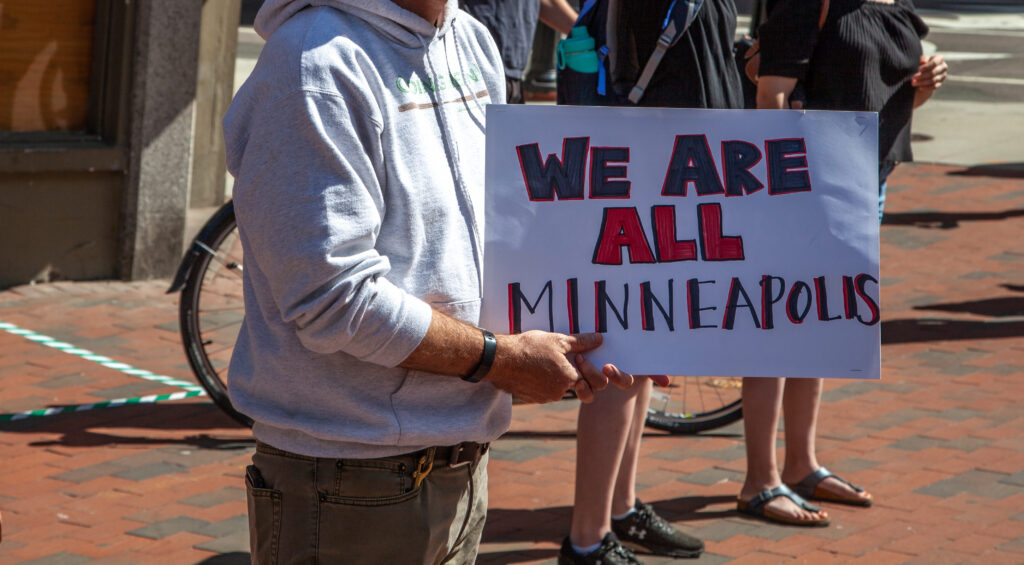
Blocking is the strategy of protection.
- It means standing up when rights are threatened.
- It means naming corruption.
- It means defending free and fair elections.
- It means saying, “This far, no further.”
When systems harm people, especially the vulnerable, silence becomes complicity.
Blocking is necessary.
More to the point: Blocking is about love.
I recently listened to some Lutheran leaders in Minneapolis/St. Paul. They have been organizing with many groups to support neighbors in terror imposed by the federal government there. They have organized food distribution, neighborhood watches, documentation, legal responses, and verbal feedback to federal agents. All within the bounds of civil rights and the law.
Their reason for doing all this work: love of neighbor.
Again, love is not a feeling, although it is often accompanied by emotions. It is a cellular commitment to the well-being, or thriving, of your neighbor.
I believe that this commitment to love of neighbor revealed in Minnesota has the power to restore our nation.
But blocking alone cannot build the future.
The Danger of Living Only in Block Mode
If our entire civic life becomes resistance, we risk:
- Burnout
- Cynicism
- Permanent outrage
- Deeper polarization
Blocking without bridging hardens divides.
Blocking without building leaves a vacuum.
Blocking is a shield of love, but it is not love’s goal.
Thriving is love’s goal.
A Word to Those Who Bridge
Sometimes bridge-builders hesitate to block, fearing it will disrupt relationships.
But relationships without justice erode trust.
Blocking harm protects the space where belonging can grow.
And… Each of us are equipped to love in different ways. One of the ways we can contribute to love is to support the ways other people are loving their neighbors. Not all of us can block. Not all of us can bridge. Not all of us can build. But we can all do what we can do – knowing that even what we do will not be perfect.
Next week I will write about the work of building the society we deserve.