
On Friday I will have the opportunity to speak with a group of leaders in Arizona who are working to reduce political violence.
They are coming from different backgrounds and different political perspectives. But they share a common concern: something is changing in our country. The tone is sharper. The distrust is deeper. And more people are beginning to justify behavior that, not long ago, most of us would have rejected.
One leader said it simply: “I’m seeing people justify worse and worse behavior.”
That sentence has stayed with me.
What Is Happening to Us?
In the conversation, I will offer a framework that has been helpful to many groups.
Political violence does not begin with weapons. It begins with how we see one another.
Human beings survived not because we are the strongest, but because we learned to cooperate. We developed what we might call a social contract—shared expectations that we would treat one another with a basic level of dignity, restrain harm, and find ways to live together.
Across cultures and traditions, this shows up in simple teachings:
- See other people as human.
- Love your neighbor as yourself
But that kind of society requires something else: relationships of trust.
When we lose this trust – the social contract – we know our survival is less assured and this leads to a dangerous cycle of escalation.
From Relationship to Slander
Today, most of us don’t actually know people from “the other side.”
Instead, we hear about them:
- Through media
- Through political messaging
- Through social media
And those stories are often shaped by fear. Over time, we begin to see whole groups not as people, but as problems. This is what we call dehumanization. It doesn’t usually start with hate. It starts when what we love—our family, our safety, our future—is framed as being under threat from another group.
Why Good People Drift
One of the most important parts of the speech in Arizona will be this:
Human beings are wired to belong. Our groups don’t just shape what we believe. They shape what we feel is acceptable.
When a group begins to justify dismissing or demeaning others, most people don’t immediately push back. They hesitate. They stay quiet. They adjust.
Not because they are bad people. But because they don’t want to lose their people.
Over time, this creates a kind of moral tension. We feel the gap between what we say we believe and what we are allowing. And the more that gap grows, the more we rely on our group to reassure us that we still belong.
When people have lost relationships, or created distance from friends or family because of political identity, it becomes even harder to step back. Instead, many double down.
This is one of the ways dehumanization takes root.
What Can We Do?
If the problem is shrinking belonging, the solution is to expand it.
At Paths to Understanding, we focus on something simple—but powerful:
We bring people together not first as “red” or “blue,” but as human beings with other identities:
- People of faith
- Neighbors
- Parents
- Community members
- People who want their community to be safe and to thrive
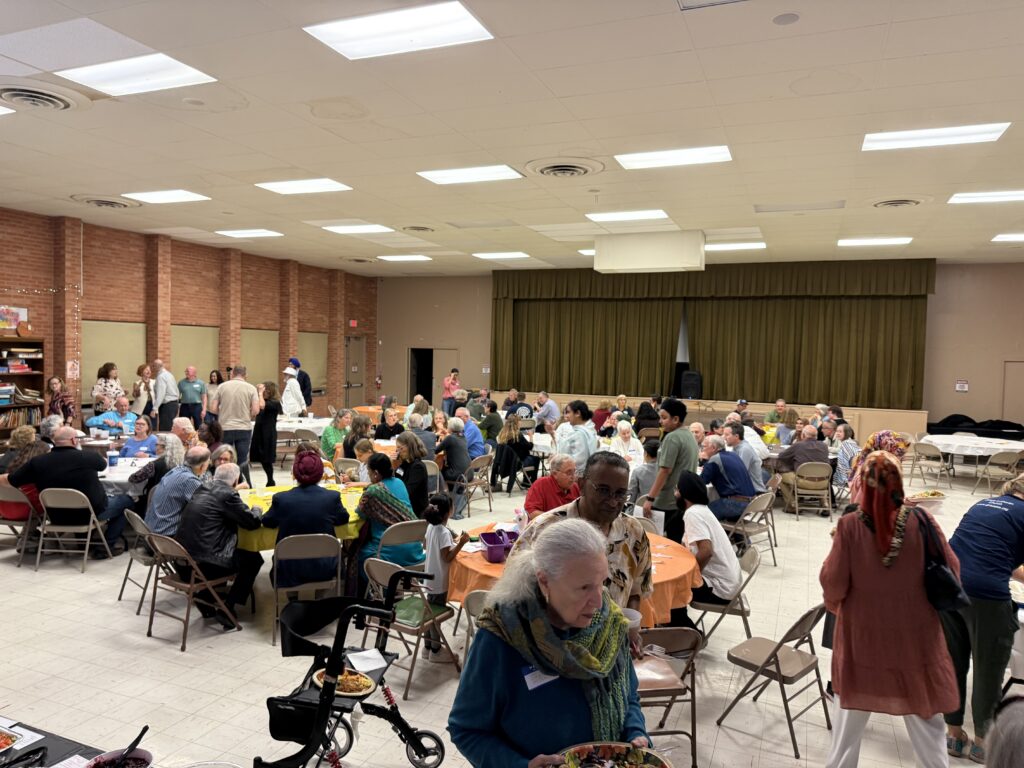
When people meet this way—face to face, sharing food, telling stories, sometimes serving together—something shifts.
- Fear decreases
- Curiosity increases
- Complexity returns
And perhaps most importantly:
People begin to experience belonging that is not dependent on seeing another group as a threat.
A Different Kind of Strength
We often think that strength comes from defending our group. But there is another kind of strength.
The strength to:
- Stay rooted in our values
- Stay connected to others
- Stay open to relationship, even in a time of tension
This is the work of building what we call belonging—the capacity to live together across difference.
This leads to another capacity we call civic muscle–the capacity to make decisions and act together for our common future.
What I Am Learning
I am learning that people don’t just defend ideas. They defend belonging.
And that means if we want to reduce political violence, we cannot focus only on arguments or policies.
We have to focus on relationships. We have to create spaces where people can experience a bigger “we.” Because when that happens, the pressure to dehumanize begins to loosen. And the possibility of a shared future begins to grow.
If you want to learn more about how to bring people together across difference, you can explore the Potluck Project and Let’s Go Together on our website.
If you want to see the resources I shared with this group, click here.
Together, we can build a society where everyone belongs and everyone can thrive.